Showing posts with label strategies. Show all posts

Monday, June 8, 2015

Everything ESL: More Tips and Resources for Working with ESL Students.

As many of my followers know I spent the last 10 years of my teaching career as an Elementary ESL Resource Teacher/Specialist for the Anchorage School District. I taught the most limited English Proficient students at my home Elementary school 5 mornings a week in my Learning Center and worked with other limited ELLs in the afternoon at my home school and 4 other schools in our district. This past January I found out that 3 new to the country Korean girls had entered my grandson's school and 2 were in his 4th grade class. You can see the 3 of them in the picture above. I was so excited and offered to come in and work with them several mornings a week. Their teachers were so happy and since they knew my background I was able to work with them in a small room with my own materials. There are very few ELL students at my grandson's school so resources were very limited. At that time their teachers were doing a lot of test prep for state assessments and their teacher's had a very limited time to work with them. They had access to Rosetta Stone and were able to read 1st grade level books on AR (Accelerated Reader). The girls were so happy to find out that I had lived in Seoul, Korea and new a little bit of Korean. At first they were really shy and quiet, especially the twins. I found out that they had only studied English with a private tutor for a few months before coming to Tallahassee.

One day the guidance counselor came to talk with me. She was new to working with ELLs and was trained to give them the IPT Oral English Language Proficiency Test. It is one that I administered more than 1,000 times over 10 years. All 3 girls were Non-English Speakers. You can find out more about this test by clicking on the image below.
Tips about Placement Tests:

  • They are usually given within the first few weeks of entering school. 
  • Students who are very limited or non-English speaking are usually very shy and may be experiencing "culture shock."
  • They must be reliable and valid. (ex: IPT Test of English Language Proficiency)
  • Administrators must be "trained"!
I have found that throughout my years of administrating these tests that after a month or so of being in school, many who test as Non-English Speaking start to feel more comfortable and safe to take risks. If the test were administered again they would probably be at the Limited English Proficiency Level and not Non- English Proficient. I found this to be true with the 3 Korean girls I began to work with as well. As I worked with them, they started talking more and more. It truly helped that I knew so much about their country and culture so we could talk about Korean food, holidays, customs, and school. Here is a picture of me with the girls after we played the Korean game of Yut which they play on Lunar New Year. They were so surprised that I had the game and knew how to play it.
In just a few short months their teachers were amazed at how much more they were talking and progressing. Soon they were able to read and answer questions in complete sentences and even sequence a story. Here are a few samples of their work.


Here are the twins with their biography report.

If I can share one important tip with all of you who have students in your classrooms like these 3 girls try to speak slower  especially when you are talking with them. They need lots of wait time to process what you say and when you speak at the same pace as you do to the whole class they probably only hear the first few words and the rest goes right over their heads. The girls told me over and over again that they could understand the material when I taught them because I spoke slower and gave them "think time." It may not seem like much but it is.  

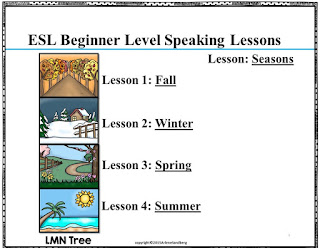
Since my last Everything ESL Post I have added 3 New Beginning Speaking Lessons to my store.
You can check them out by clicking on each image below.


I finally bundled up my 1st 5 ESL Lessons which you can check out by clicking on the image below. You can save more than 20% on this bundle!
You can get a free ESL Beginner Speaking Lesson and get more tips and resources by clicking on the image below:
I have one more free resource for you. I just added this Free ESL Reading and Writing Lesson to my TpT Store. It is a great companion to my ESL Beginning Speaking Lesson: The Four Seasons. I hope you will leave feedback. 

Thanks for all you do to make a difference for your students.
Don't forget to follow me on Pinterest by clicking HERE You may also like my Everything ESL Pinterest Board.

Follow my blog with Bloglovin Teaching Blog Addict

Tuesday, December 2, 2014

Winter Writing: Tips, Activities, and Freebies

Over the last year I have been talking about helping students with the writing process. By now those of you who teach 1st and 2nd grade have been spending lots of time on teaching writing and having your students write. With winter approaching many Kindergartners will begin writing, too. In order for students to write they need ideas. Seasons offer so many wonderful ideas for writing. Whether you have a long winter, short winter, or no winter, kids love to read about winter activities, winter weather, and things that happen in winter. For ESL students and students below grade level writing is a very difficult task. That's why I like teach teaching with themes and teach language standards through the theme or subject.

To begin with, students need to know:

  • What a sentence is
  • How to construct a sentence-Word order
  • What parts does a complete sentence need to have
  • Capitalization, Punctuation, Spelling rules
  • Lot of words
You can read a lot more about writing by clicking HERE.
You can download these free Sentence frames by clicking on the image below: They are included in my packet and can be used for whole class instruction with understanding the parts of the sentence as you see in the image below the frames.
Last spring I wrote my first Writing Sentences Using Sentence frames and then added one for Fall and Back to School. I had such a good response and feedback that I just uploaded my Winter Writing Activities Packet.  It is very similar to my other packets except it uses winter words and ideas. I actually added more activities to give students more writing practice. There are some whole class activities to assess students' understanding before students do the activities independently in your writing centers. First, students need to learn the vocabulary words and then learn what a sentence is and is not. Then they get to practice using sentence frames to make 12 sentence and writing 5 of them on their recording sheet. They will need to capitalize the first letter and end each sentence with a period. There are both 3 sentence frame part sentences and 4 sentence frame part sentences depending on the needs of your students.
Then students will match a picture with a sentence that describes it and write each sentence part on their recording sheet.
After that they get to unscramble sentences, write the complete sentence and draw a picture to go with their sentence. Finally, they are assessed with being able to write complete sentences by using winter words that are written in a snowball. There is one for 1st grade and one for second. 
You can read the description, table of contents, and download the Preview file to see all the materials and activities in this unit by clicking on the image below.

I also just uploaded this Winter Writing Activities Freebie Packet which would make a great companion to my unit. Students will label and write about the picture like the one below.
Or write a short story about one of two photos like the one below.
To download your free packet just click on the image below. Please don't forget to leave feedback.


Don't forget to checkout all my Pinterest Boards.  Click HERE to follow. Thanks for all you do to make a difference for your students. Hope your students enjoy writing about winter.

Follow my blog with Bloglovin
TBA

Saturday, July 26, 2014

Building Fluency: Tips, Strategies, Activities, and Freebies

Fluency is one of the important big ideas of reading. What research tells us is that students can become fluent by:
  • Explicit instruction, guidance, and feedback
  • Practicing reading with appropriate texts
The best way to build fluency is through Repeated Readings. Here is a great video of 1 Repeated Reading Method I have seen used. I used a different one where after the 1st reading I have my students go back and practice reading it a few times before timing them again. Students love graphing their progress! 


You can download a Research Report on Fluency by clicking HEREFor many beginning and struggling students fluency begins with words,  phrases, and sentences before they are ready to read texts.

Paired Unison Reading is another strategy where teachers or other adult readers can practice reading in unison with the struggling reader until the struggling reader feels ready to read alone. If the struggling reader makes an error the teacher or adult reader corrects the word, then practices that sentence in unison with the struggling reader and then the struggling reader continues alone. Research by Topping and Whitley (1987, 1990) found that this method of paired reading can significantly improve reading fluency.

Parents can be very instrumental in helping students build fluency. At home parents can read a poem or passage to their child followed by reading in unison and then having the child read the poem or passage to the parent.

Choral reading is another great strategy for building fluency. It engages 100% of your students with lots of reading opportunity. It is highly recommended as part of your fluency building instruction.

Another great strategy I have used a lot with my ESL and Struggling Readers is Echo reading. This is a strategy where the teacher reads a sentence or paragraph and the student listens and follows. After the teacher stops, the student echos back the same sentence or paragraph following with their finger to make sure they haven't memorized what you have read.

I have created a new "Back to School" Fluency Activities Packet  that helps students build fluency with words, phrases, sentences, texts, poems, and readers theater all related to the theme of "Back to School." Using themes to build fluency gives students more time to see, say, read, and write the targeted vocabulary which not only helps build fluency but makes them feel more successful. You can use all of the strategies above with the texts, poems, and readers theater in this packet.

The Word Fluency Activities include Picture/Word Cards, Word Cards for Fluency Match Games, "Point and Say" Fluency Activities, a fun Card Game "Roll the Die and Read the Word" Game and Word Reading Assessments.
There are several activities at the Phrase and Sentence level of fluency and assessments as you can see below.
Finally there are Sentence Building Fluency Cards, Reading Texts that are differentiated at the 1st and 2nd grade reading levels, Poems, and a Readers Theater script as well as Reading Texts for Assessment with Student Progress Reading Charts.
You can download the Preview file to see sample pages of all the materials and activities in this packet.
I have put together a free "Back to School" Fluency Activities Packet which includes Fluency Building Cards and a Readers Theater Script that are all new and would be a great addition to the complete packet above.
You can download this free Back to School Fluency Packet by clicking on the image below.
You may also be interested in following me on Pinterest. You can see all my new Pinterest Boards by clicking HERE.
Here's my most popular one.


Follow my blog with Bloglovin

Thanks for all you do to make a difference for your students. Enjoy the rest of your summer vacation!
Freebie Fridays

Wednesday, January 9, 2013

Vocabulary Matters: Strategies That Work! Part 1-Introduction


When I first started blogging I wrote a post about the importance of explicit vocabulary instruction. At the time I had very few followers and viewers so I thought it was a topic worth revisiting in hopes of reaching more teachers. Having worked in a Title I school for many years as an ESL Resource teacher I did a lot of research into vocabulary development. One of the best research studies came from Hart and Risley, 1995. "Children come to school with meaningful differences in vocabulary knowledge. According to their research what matters is a student's relative economic advantage. Children living in poverty hear one-third the number of words per minute than those of the working class. Not only was there a difference in numbers of words but also in quality. Students living in poverty aren't exposed to rich, robust words and by the time they enter school the vocabulary knowledge gap is even wider." Explicit Vocabulary Instruction is necessary to help bridge that gap for these students . "Vocabulary occupies an important position both in learning to read and in comprehending text: readers cannot understand text without knowing what most of the words mean (National Reading Panel 2000)." It goes on to say that to develop vocabulary students should be explicitly taught both specific words and word-learning strategies. Such instruction often doesn't begin with a definition  for giving a definition usually means that the student already knows what the word means. What rich and robust vocabulary instruction does is to go beyond knowing the definition of a word but to actively engage students in using and thinking  about word meanings and to create and make connections among words. For those who struggle to read or come to school deficient in rich and robust vocabulary acquisitions needs to be accelerated if there is any hope of these learners catching up with their peers.

What is vocabulary?  
  • It is the knowledge of words and their meanings.
Vocabulary instruction involves much more than looking the words up in the dictionary and using the words in a sentence. 

Four components of  an Effective Vocabulary Program 
  1. Extensive independent reading to help expand world knowledge
  2. Specific word instruction to help improve understanding of texts containing those words
  3. Instruction in independent word-learning strategies
  4. Word-consciousness and word-play activities to motivate and enrich learning
Today I would like to introduce Components 2-4 and what I will be writing about in my upcoming posts called "Vocabulary Matters: Strategies that Work" 


I will be referring to a book entitled  "Vocabulary Handbook" written by Linda Diamond and Linda Gutlohn.  I was very fortunate to have taken several workshops from Linda Diamond and it truly changed the way I approached teaching vocabulary. I hope you will take this journey with me and find some great ideas and strategies to try with your students. Today is an introduction to what I will sharing with you in the coming weeks.  I hope to give you research-based knowledge, practical applications and sample activities to improve vocabulary instruction. It will include:
Word learning Strategies

  • Dictionary use
  • Morphemic analysis- figuring out a word's meaning by analyzing it's meaningful parts: morphemes (root words, prefixes, suffixes)
  • Contextual analysis- figuring out the meaning of an unknown word by looking closely at the text surrounding the word.
Along with word learning strategies there will be information to help:
  • Cultivate word consciousness- getting our students to become aware of and interested in words.
  • Give students multiple exposures to words in multiple contexts
  • Restructure strategies- making sure that students fully understand the instructional task.
  • Foster incidental vocabulary learning- through engagement in rich oral language experiences, listening to books during read alouds and reading widely on their own.

You can download a copy of Part I by clicking on the image at the top of the post. I hope you will let me know if this is helpful for you.

I've added lots of new Pinterest Boards for you to follow. You can access them by clicking HERE
You will find Grade level boards from Preschool through 5th grade, Seasonal Boards and many more.
Here's my most popular one.


Follow my blog with Bloglovin

Thanks for all you do to make a difference for your students.


How much time do you spend each day on vocabulary instruction?